
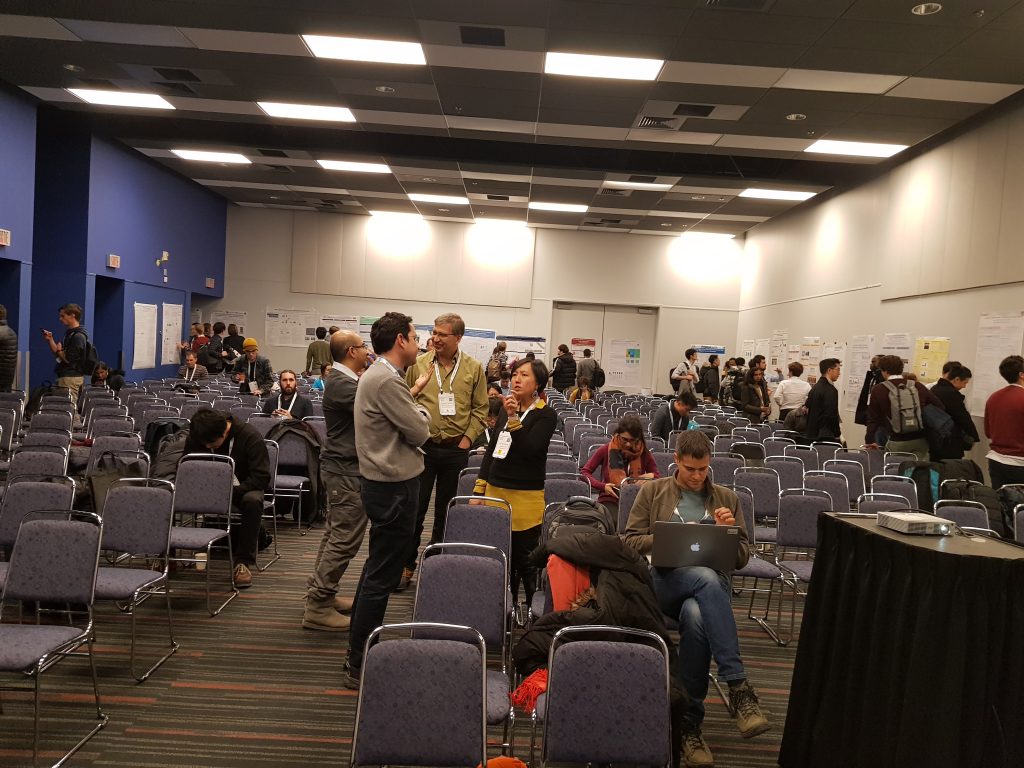
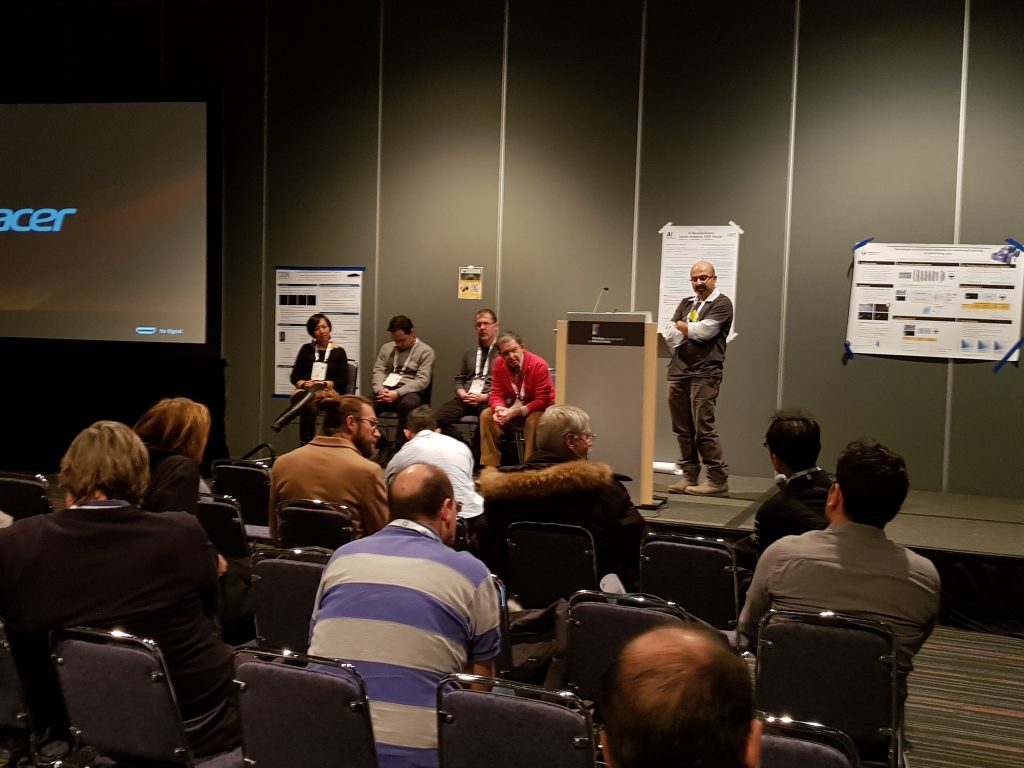
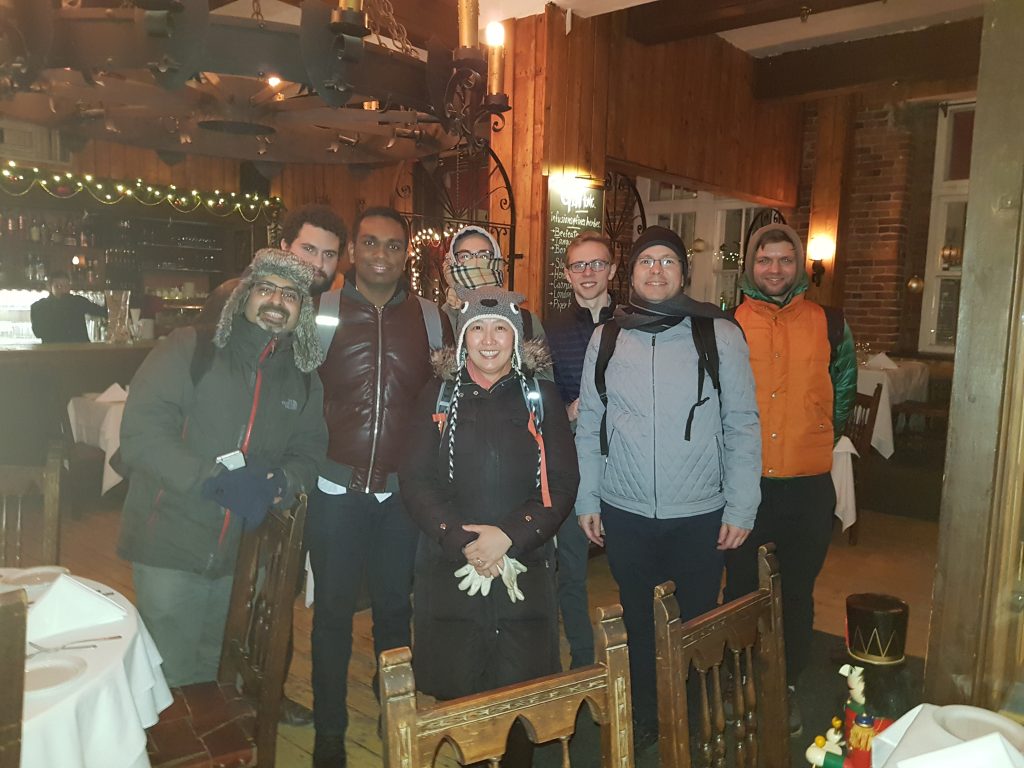
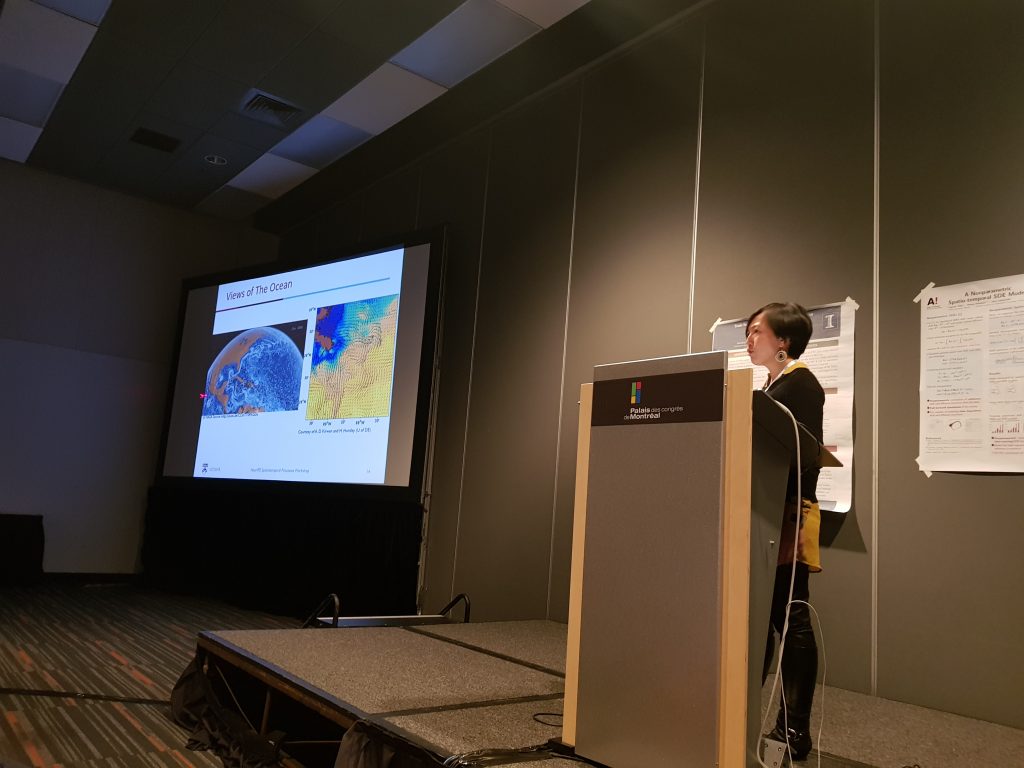
Ani presented a talk titled Modeling, Tracking, and Learning Coherent Spatiotemporal Features in Geophysical Flows at the 32nd Annual Conference on Neural Information Processing Systems (NIPS) for the Spatiotemporal Workshop. Check out some pictures from the workshop below.
Author Archive: M. Ani Hsieh, Ph.D.
Coordinating AGVs for Automated Warehouses
Coordination of multiple AGVs: a quadratic optimization method
Status: Published in Autonomous Robots. Preprint to come.
Planning Optimal Paths in General Flows
Going With The Flow: A Graph Based Approach to Optimal Path Planning in General Flows
Dhanushka Kularatne, Subhrajit Bhattacharya, and M. Ani Hsieh
Abstract: Autonomous surface and underwater vehicles (ASVs and AUVs) used for ocean monitoring are typically deployed for long periods of time and must operate with limited energy budgets. Coupled with the increased accessibility to ocean flow data, there has been a significant interest in developing energy efficient motion plans for these vehicles that leverage the dynamics of the surrounding flow. In this paper, we present a graph search based method to plan time and energy optimal paths in static and time-varying flow fields. We also use tools from topological path planning to generate optimal paths in different homotopy classes to facilitate simultaneous exploration of the environment by multi-robot teams. The proposed strategy is validated using analytical flow models, actual ocean data, and in experiments using an indoor laboratory testbed capable of creating flows with ocean-like features. We also present an alternative approach using a Riemannian metric based approximation for the cost functions in the static flow case for computing time and energy optimal paths. The Riemannian approximation results in smoother trajectories in contrast to the graph based strategy while requiring less computational time.
Status: Accepted and to appear in Autonomous Robots. Preprint to come.
Cooperative Transport by ASVs
Differential Geometric Approach to Trajectory Planning: Cooperative Transport by a Team of Autonomous Marine Vehicles
Hadi Hajieghrary, Dhanushka Kularatne, and M. Ani Hsieh
Abstract: In this paper we addressed the cooperative transport problem for a team of autonomous surface vehicles (ASVs) towing a single buoyant load. We consider the dynamics of the constrained system and decompose the cooperative transport problem into a collection of subproblems. Each subproblem consists of an ASV and load pair where each ASV is attached to the load at the same point. Since the system states evolve on a smooth manifold, we use the tools from differential geometry to model the holonomic constraint arising from the cooperative transport problem and the non-holonomic constraints arising from the ASV dynamics. We then synthesize distributed feedback control strategies using the proposed mathematical modeling framework to enable the team transport the load on a desired trajectory. We experimentally validate the proposed strategy using a team of micro ASVs.
Status: To be presented at ACC 2018. Preprint to come.
Upcoming ACC 2018 Presentation
Check out Hadi’s ACC 2018 paper entitled “Differential Geometric Approach to Trajectory Planning: Cooperative Transport by a Team of Autonomous Marine Vehicles“. The presentation will be on Wednesday, Jun 27 at 13:50-14:10.
Path Planning with Forecast Uncertainties
Optimal Path Planning in Time-Varying Flows with Forecasting Uncertainties
Dhanushka Kularatne, Hadi Hajieghrary, and M. Ani Hsieh
Abstract: Uncertainties in flow models have to be explicitly considered for effective path planning in marine environments. In this paper, we present two methods to compute minimum expected cost policies and paths over an uncertain flow model. The first method based on a Markov Decision Process computes a minimum expected cost policy while the second graph search based method, computes a minimum expected cost path. A transition probability model is developed to compute the probability of transition from one state to another under a given action. In addition, a method to compute the expected cost of a path when it is executed in an uncertain flow field is also presented. The two methods are used to compute minimum energy paths in an ocean environment and the results are analyzed in simulations.
Status: To be presented at ICRA 2018 in Brisbane, Australia. Preprint to come.
Upcoming ICRA 2018 Presentation
Check out Dhanushka’s ICRA 2018 paper entitled “Optimal Path Planning in Time-Varying Flows with Forecasting Uncertainties“. The presentation will be on Wednesday, May 23 from 14:30-17:00.
Upcoming ICRA 2018 Workshop
Ani is co-organizing the ICRA 2018 Workshop on Robot Teammates Operating in Dynamic, Unstructured Environments with Nick Roy (MIT), Henrik Christensen (UCSD), Fox Dieter (U of Washington), Stuart Young (ARL), Dirk Schulz (FKIE), Ethan Stump (ARL), and Chris Reardon (ARL). The workshop will be held on Monday, May 21st. The workshop program can be found here.
Information Based Search in Turbulent Flows
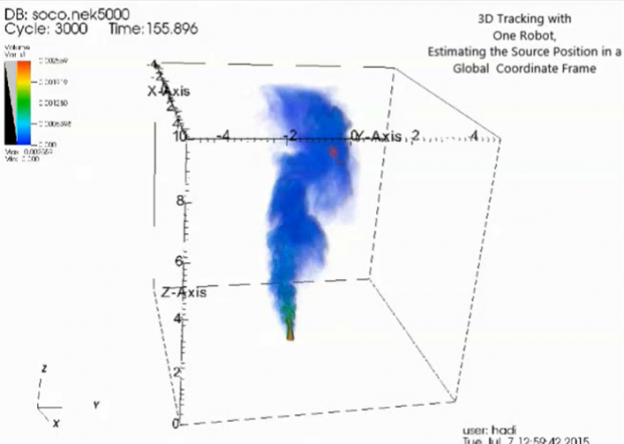
Variations in material concentration resulting from a biochemical or radiological contaminant leakage, such as an oil spill in the ocean or a radioactive dispersal in the atmosphere, is dominated by turbulent mixing. The result is a highly anisotropic and unsteady sensory landscape where sensor measurements become the sporadic and intermittent which renders gradient based search strategies highly ineffective. This work develops information based search strategies for autonomous robots to search and localize the source of a biochemical contaminant dispersed in turbulent media. The approach has been validated using state-of-the-art 3D computational fluid models of the 2010 Deep Water Horizon oil spill developed by Dr. Alex Fabregat Tomás at CUNY.
Grant: CARTHE-II
Path Planning
Optimal Paths in Flows
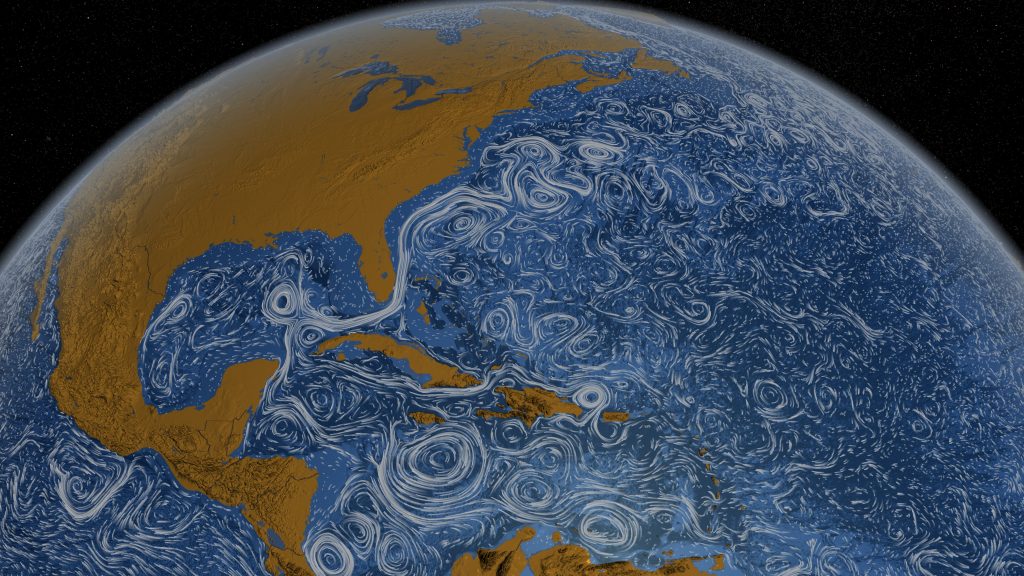
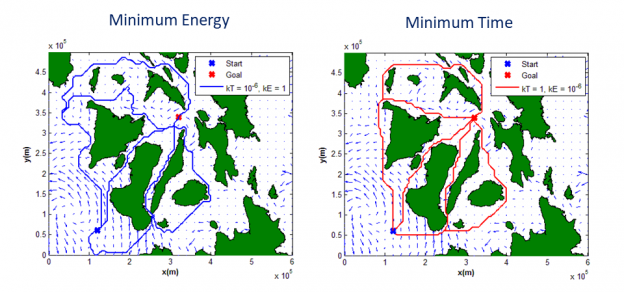
Autonomous marine vehicles (AMVs) are typically deployed for long periods of time in the ocean to monitor different physical, chemical, and biological processes. Given their limited energy budgets, it makes sense to consider motion plans that leverage the dynamics of the surrounding flow field so as to minimize energy usage for these vehicles. This project focuses on developing suitable graph search based techniques to compute energy and/or time optimal paths for AMVs in two- and three-dimensional time-varying flows (2D+1 and 3D+1). This project has contributed novel techniques that can capture the kinematic actuation constraints on the vehicles in our cost functions, generate optimal paths in different homotopy classes, and employ an adaptive discretization scheme to construct the search graph. Our current efforts are focused on how best to leverage coherent structure information into our strategies.
This work is a collaboration between Dr. Subhrajit Bhattacharya at Lehigh University.
Papers
- D. Kularatne, M. A. Hsieh, and E. Forgoston. “Using Control to Shape Stochastic Escape and Switching Dynamics,” Chaos 29, 053128 (2019); https://doi.org/10.1063/1.5090113. Bibtex | PDF
- D. Kularatne, S. Bhattacharya, and M. A. Hsieh. “Going With The Flow: A Graph Based Approach to Optimal Path Planning in General Flows,” Autonomous Robots: RSS 2016 Special Issue, 42(7), Oct 2018, pp 1369 — 1387. Bibtex | PDF
- D. Kularatne, E. Forgoston, and M. A. Hsieh. “Exploiting Stochasticity for Navigation in Gyre Flows,” in the Proc. of the 2018 Robotics: Science and Systems (RSS 2018), Jun 2018, Pittsburgh, PA USA. Bibtex | PDF
- H. Hajieghrary, D. Kularatne, and M. A. Hsieh. “Differential Geometric Approach to Trajectory Planning: Cooperative Transport by a Team of Autonomous Marine Vehicles,” in the Proc. of the 2018 IEEE American Control Conference, Jun 2018, Milwaukee, WI USA. Bibtex | PDF
- D. Kularatne, H. Hajieghrary, and M. A. Hsieh. “Optimal Path Planning in Time-Varying Flows with Forecasting Uncertainties,” in the Proc. of the 2018 IEEE International Conference on Robotics and Automation (ICRA2018), May 2018, Brisbane, Australia. Bibtex | PDF
- D. Kularatne, S. Bhattacharya, and M. A. Hsieh. “Optimal Path Planning in Time-Varying Flows using Adaptive Discretization,” IEEE Robotics and Automation Letters (RA-L), 3(1), Jan 2018, pp. 458-465. Bibtex | PDF
- D. Kularatne and M. A. Hsieh. “Tracking Attracting Manifolds in Flows,” Autonomous Robots, 41(8), Mar 2017, pp. 1575–1588. Bibtex | PDF
- D. Kularatne, S. Bhattacharya, M. A. Hsieh. “Time and Energy Optimal Path Planning on a Flow Field,” in the Proc. of the 2016 Robotics: Science and Systems (RSS2016), Jun 2016, Ann Arbor, MI USA. Bibtex | PDF
Path Planning for a Magnetic Millirobot
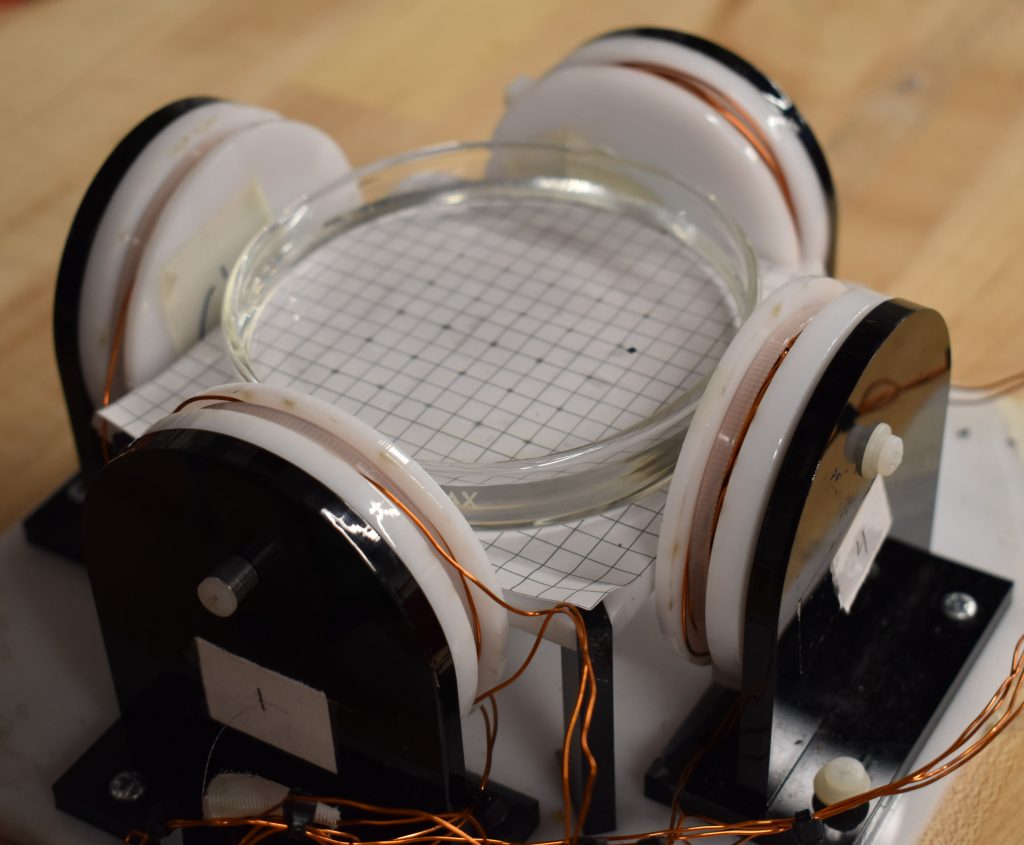
For actuation of small-scale robotic systems, magnetic control methods have garnered significant interest since magnetic fields can be selectively applied without affecting non-magnetic materials. Existing approaches for the control of single or multiple microrobots operating in magnetic fields have mostly focused on two aspects of the problem: 1) design of the physical geometry of the robot, and 2) design of devices to manipulate the local magnetic field. Instead of focusing on ways of manipulating the local magnetic field or the physical geometry of the robot, this project investigates how global design of the field topology can be leveraged for control and manipulation of microrobots. A significant advantage of leveraging topological features of the force vector field is that it does not require complete knowledge of the field and yet results in comparable performance to vehicles following optimal paths where the vector field has been explicitly accounted for.
We create a path planning and trajectory following strategy for a magnetic millirobot that leverages the nonlinearities in the external magnetic force field (MFF). The strategy creates a library of candidate MFFs and characterizes their topologies by identifying the unstable manifolds in the workspace. The path planning problem is then posed as a graph search problem where the computed path consists of a sequence of unstable manifolds segments and their associated MFFs. By tracking the robot’s position and sequentially applying the MFFs, the robot navigates along each unstable manifold until it reaches the goal.
Videos
Papers
- A. Mansfield, D. Kularatne, E. Steager, and M. A. Hsieh, “A Topological Approach to Path Planning for a Magnetic Millirobot,” Submitted to Proc. of the IEEE/RSJ International Conference on Intelligent Robots and Systems (IROS2020), Under Review, Oct 2020, Las Vegas, NV.